
Hiring insights
We Scored Twelve Resumes Against a Live Job Ad. Here’s What Came Back.
A real-world Talentranx case study: twelve resumes assessed against every requirement for a Business Project Manager role, in three minutes.

Twelve resumes, one specialist role and a shortlist needed by lunch — it’s already 11am and you have a meeting scheduled. Challenge accepted!
That is a common enough scenario for anyone who hires regularly. Applications come in and for whatever reason are not triaged and a hiring manager or recruiter is suddenly looking at a stack of resumes that all need to be read, compared, and ranked against a job description with a dozen distinct requirements. The clock is already ticking and you have a day job to do.
This walkthrough uses a real, anonymised Business Project Manager contract role sourced from Seek, and twelve resumes scored against it in Talentranx. The screenshots below show every step of the process, from pasting the job ad to a ranked shortlist with evidence behind every position.
Key Takeaways
- Twelve resumes for a specialist contract role were scored against 12 extracted requirements in approximately 3 minutes total processing time.
- Of the twelve, 3 candidates were flagged as strong interview candidates with high role fit, and 5 fell into the Moderate band — giving the hiring manager a clear decision framework before a single interview was scheduled.
- Requirement-level scoring makes those gaps visible and translates them into specific interview questions. It is evidence-based resume scoring in practice: every candidate measured against the same requirements, with reasoning attached to each score.
- The full process, from pasting the job ad to a ranked, evidence-backed shortlist, took about 3 minutes.
The role
The position was a short-term contract supporting a business process improvement project in its discovery phase. The job description was specific about scope: business-focused rather than technical IT, working with subject matter experts (SMEs) and an external delivery partner across requirements gathering, user acceptance testing, governance, and implementation.
That specificity matters. A role with this many distinct workstreams: stakeholder engagement, requirements gathering, test coordination, risk management, governance reporting, and external partner coordination, creates real trade-offs between candidates. Someone strong on stakeholder engagement may be light on formal governance. Someone with deep Business Analysis experience may be short on a project delivery track record. A single aggregate score without requirement-level detail would hide those differences.
Step 1: Set up the scoring review
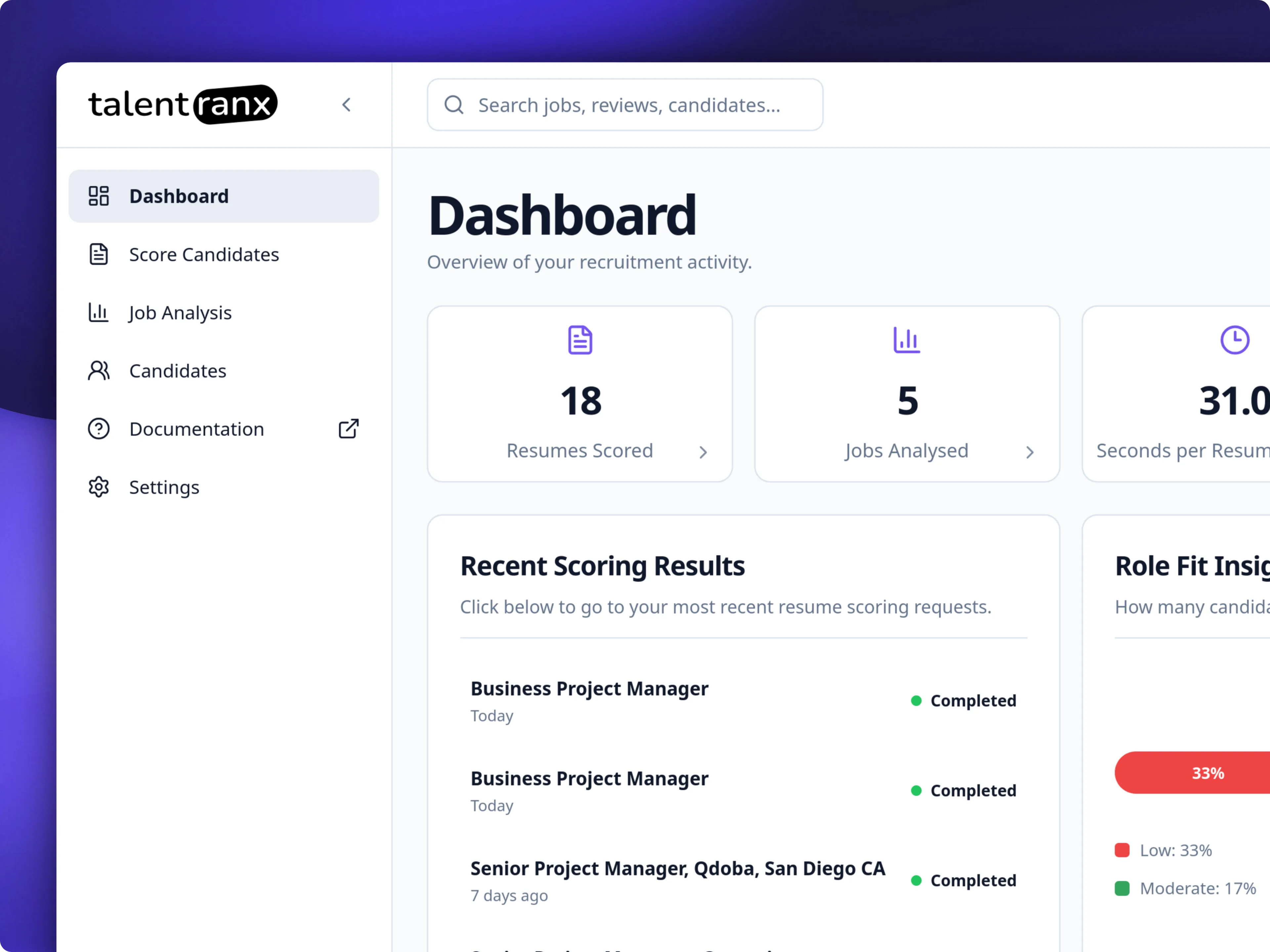
To orient ourselves, we’ll start from the Talentranx dashboard. To start scoring, we select the Score Candidates option in the left sidepanel menu.
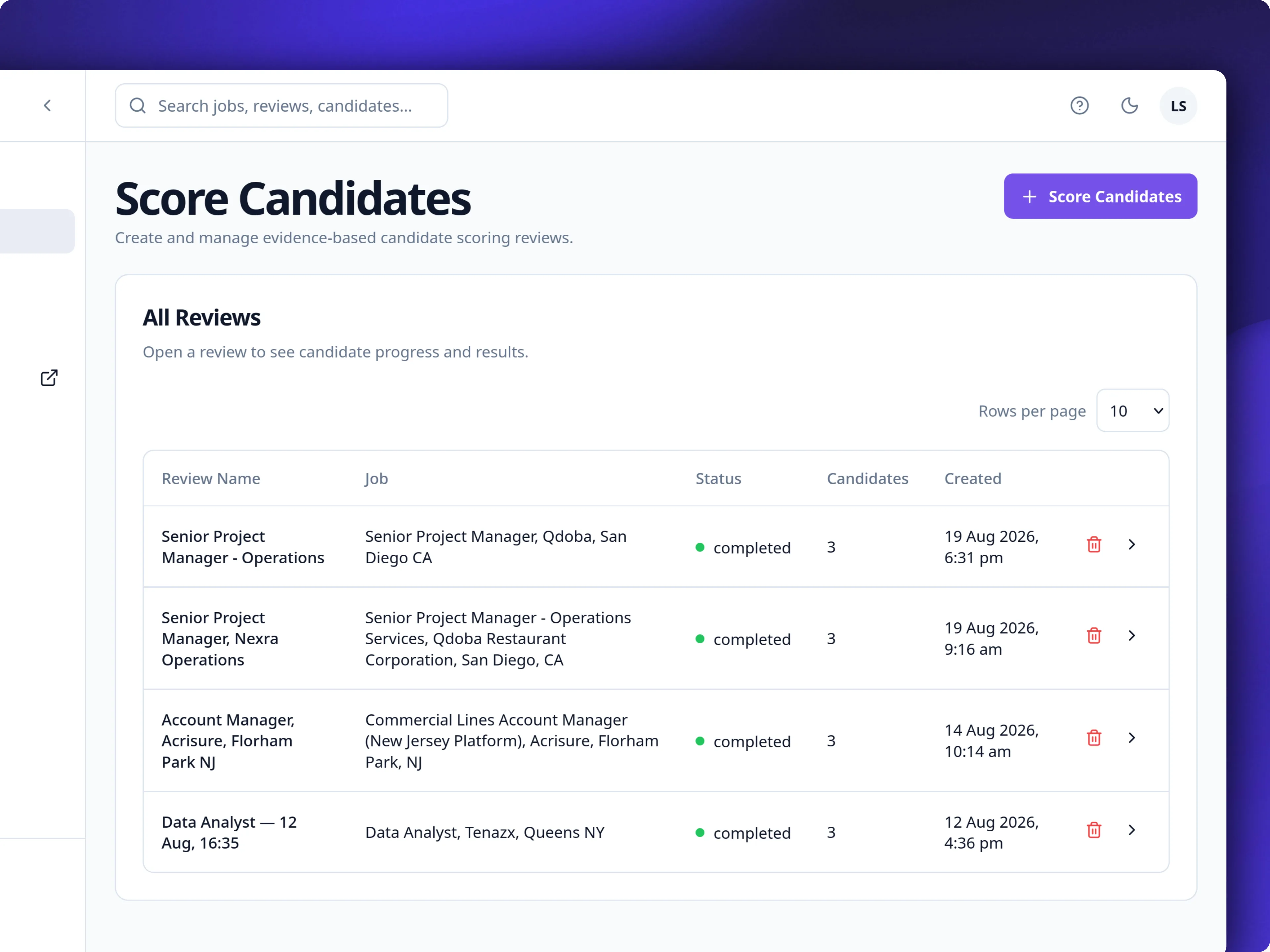
This shows a list of all your roles scored. To score a new role, click the + Score Candidates button in the top right corner.
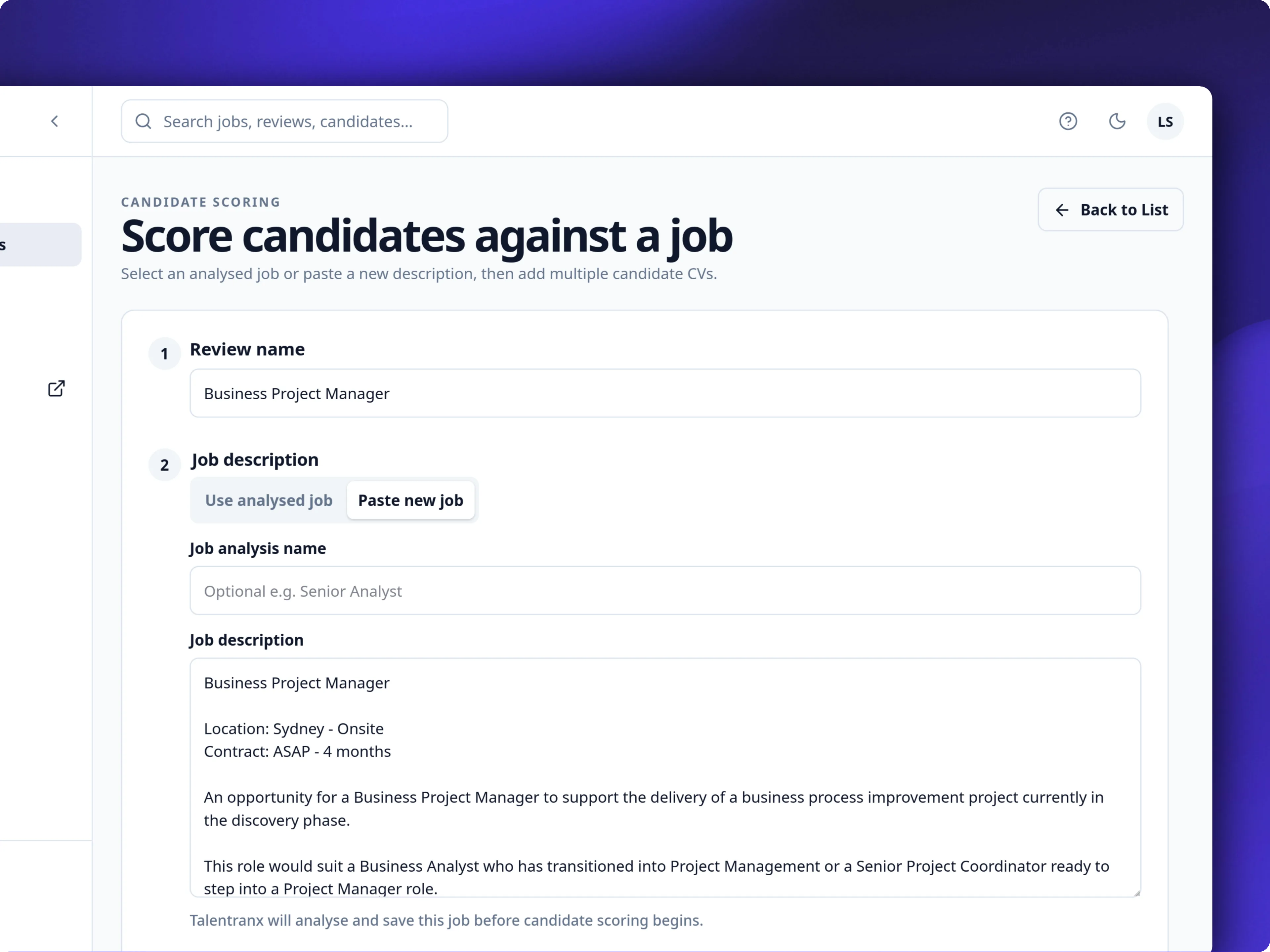
Once we’re on the Score Candidates screen, all the required input can be provided. The job description goes in — a straight copy/pasted from the Seek ad — along with a name for the review.
Scroll down to upload all resumes - drag and drop or select from your folder where you have them stored. Talentranx reads resume files directly in the browser. The original files are not uploaded to the server; only the extracted text is sent for scoring.
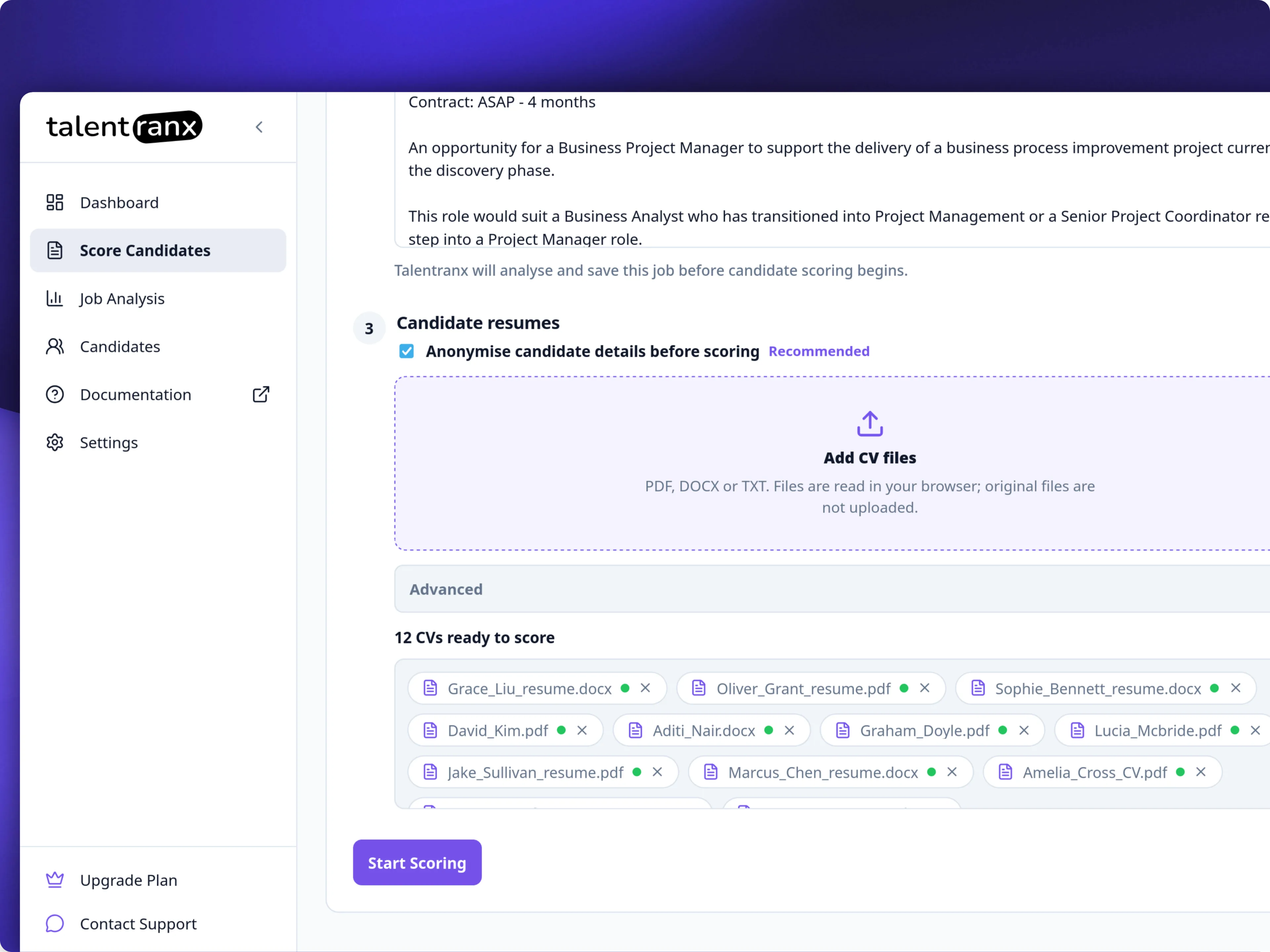
With the job description and resumes loaded, scoring starts with one click.
Step 2: Job requirements are extracted first
Before any resume is assessed, Talentranx analyses the job description and builds a list of key requirements. This is the standard Talentranx applies to every candidate and maximises consistency.
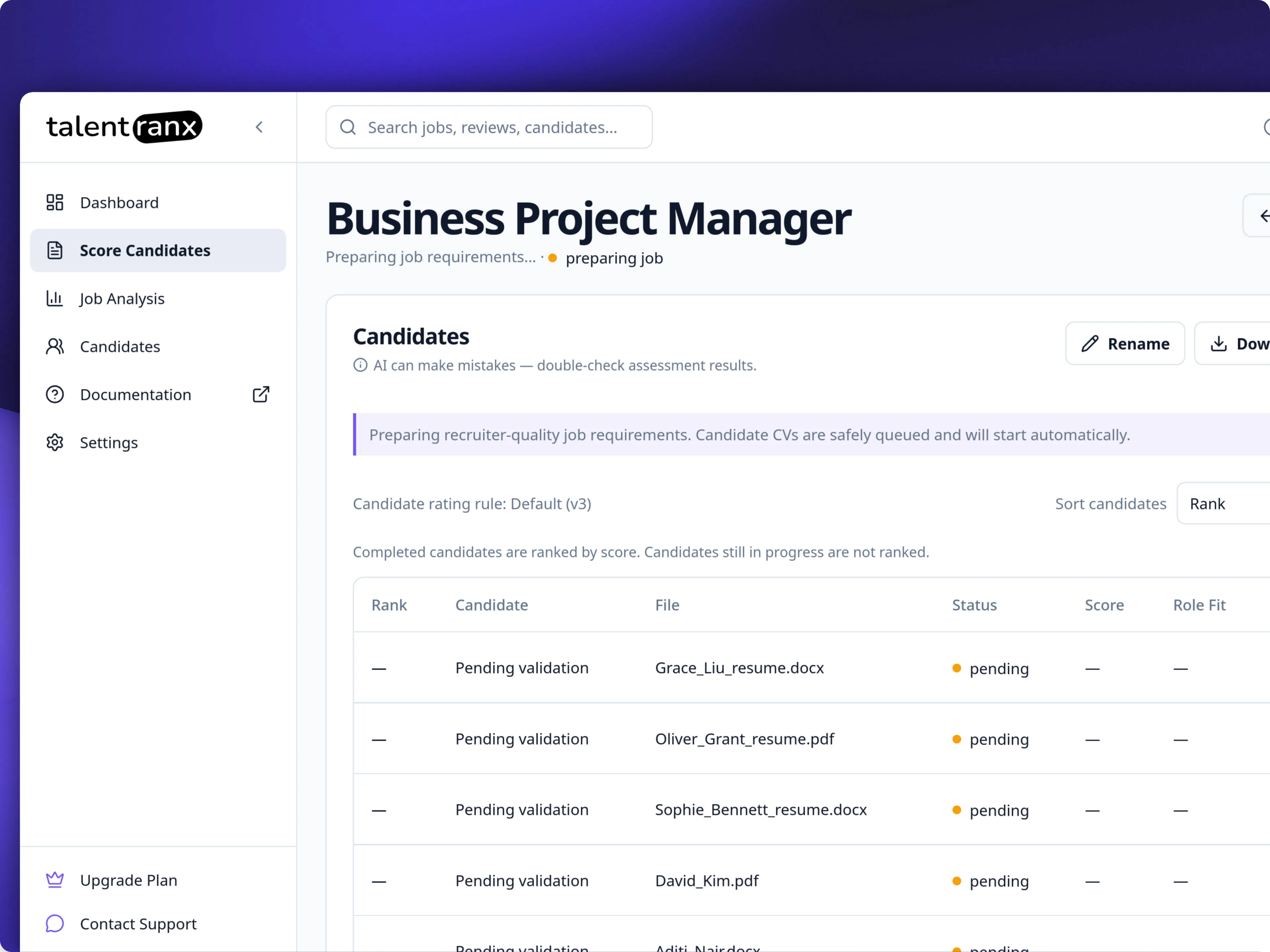
Not shown here but behind the scenes, 12 requirements were extracted: most classified as must-have and one as a bonus (finance operations exposure). The list covers the full scope of the role: end-to-end project delivery, stakeholder engagement, requirements (BRD) sign-off, test planning, risk and issue management, governance documentation, external partner coordination, and process improvement experience.
In this run we have extracted job requirements as part of the scoring process. After scoring, you can view the requirements via the Job Analysis menu option in the left sidepanel. This is shown below to give you a sense for the job analysis results (only the first 8 are shown in this screen capture - you get the picture).
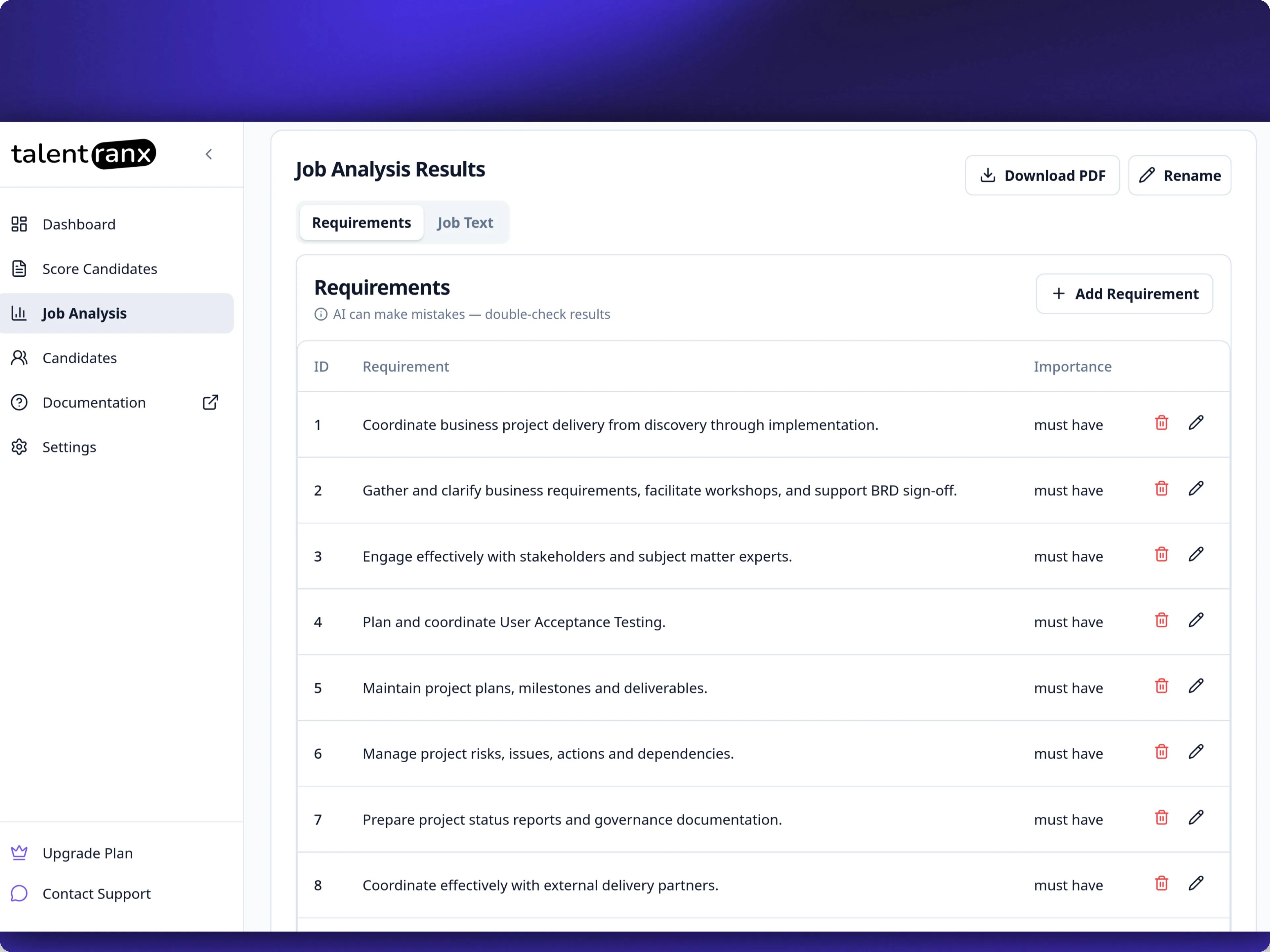
Alternatively, you can extract job requirements separately and requirements can be reviewed and edited before scoring begins. Items can be added, removed, reworded, or reclassified which can be useful when additional or late breaking requirements emerge.
Step 3: resumes are scored
Once the job requirements are locked, Talentranx scores each resume against every requirement. Candidates move through processing and completed scores appear as they finish. The status column shows which are done and which are still running.
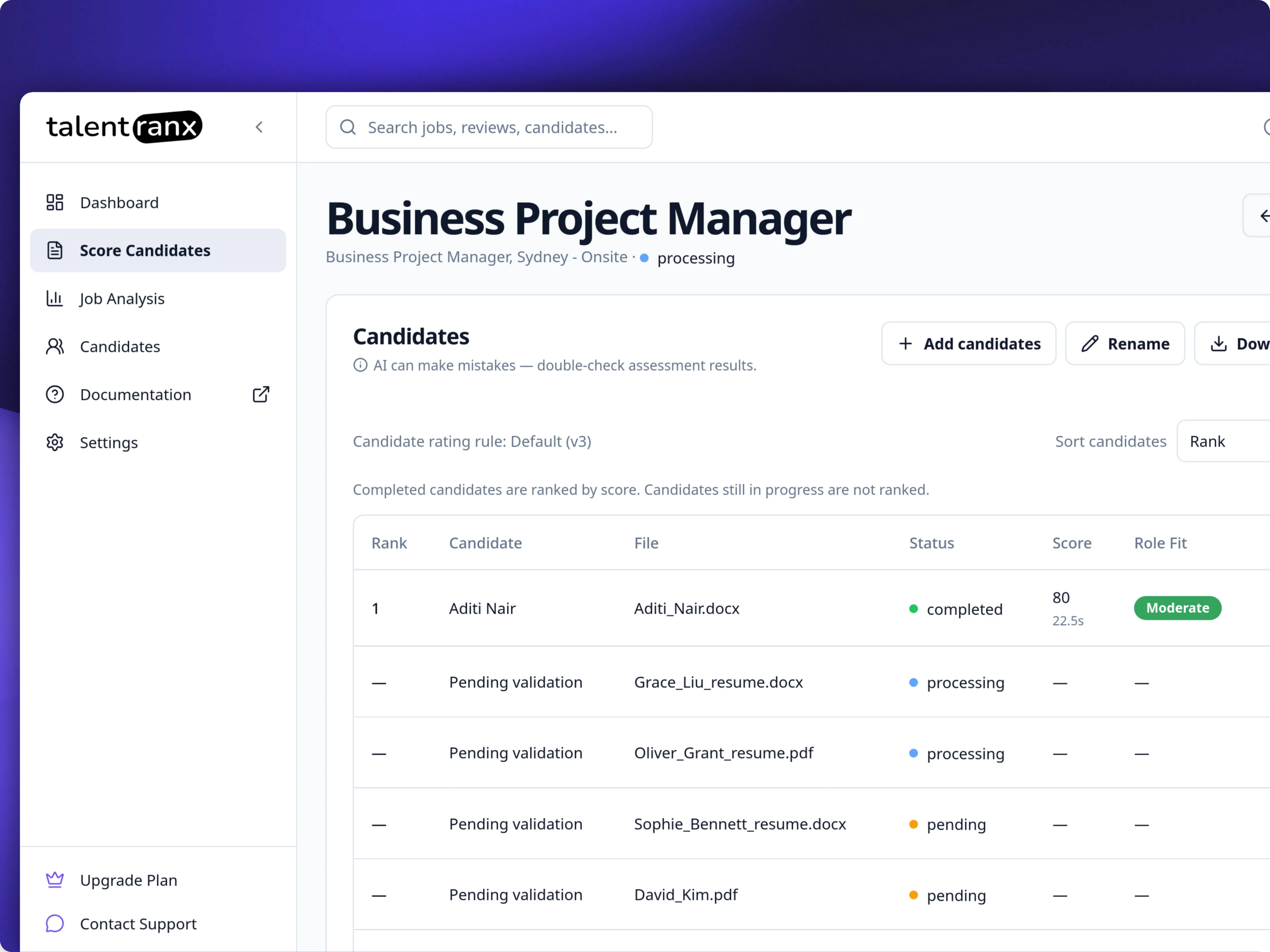
The full batch of all resumes completed in about 3 minutes. Every candidate’s resume matched against every requirement and evidence of past experience captured and summarised.
Step 4: The ranked shortlist
When processing completes, candidates are ranked by score with a Role Fit band attached to each.
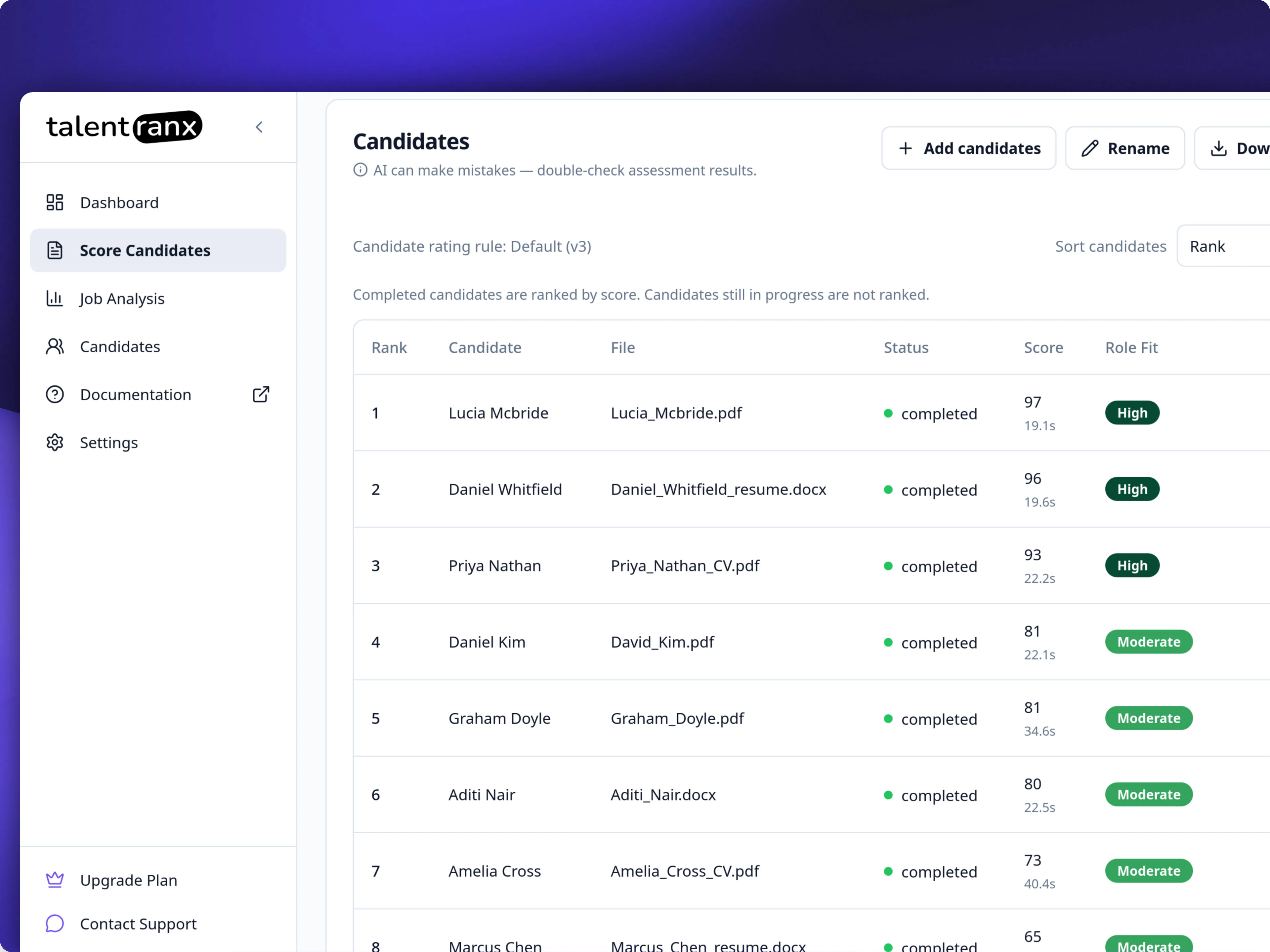
Three candidates score in the high band, five in the moderate band, and four below that round off the field.
That distribution is useful before a single interview is scheduled. The highest fit candidates have been identified and the middle of the field can be scanned as backups, wildcards or for other similar roles.
Step 5: Understanding the scores
Clicking through to any candidate opens the full assessment. The view for Amelia Cross illustrates how the detail works.
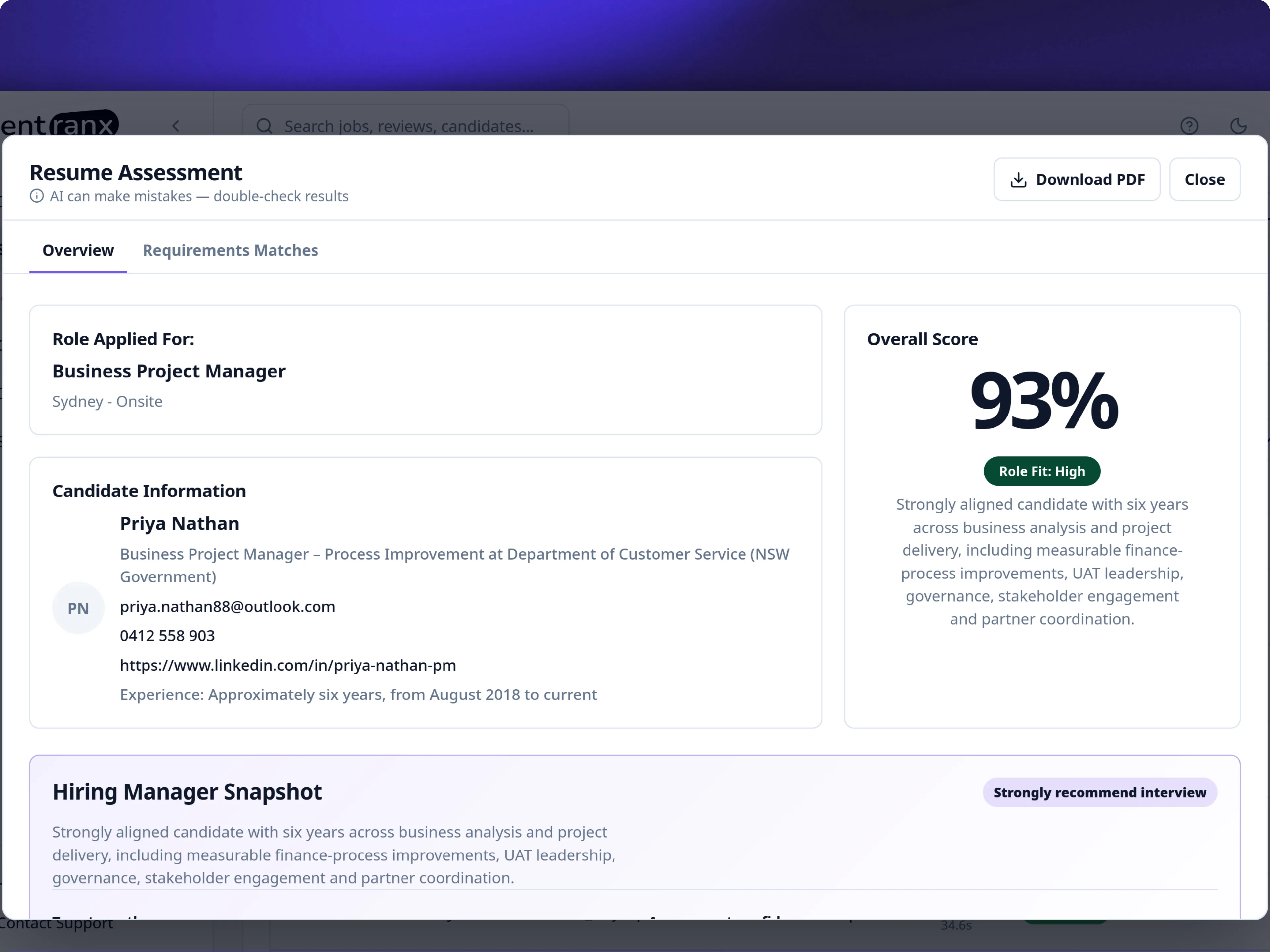
Amelia scores 70 with a Moderate role fit. The Hiring Manager Snapshot gives a plain-English read: strong BA candidate with good requirements elicitation, workshop facilitation, process improvement, and vendor coordination experience. The system recommends interview, but with caveats.
The Evidence Summary shows 7 requirements strongly evidenced, 5 moderately evidenced, and 8 of 12 mandatory requirements satisfied. That last number is what matters: four mandatory requirements are not yet confirmed by the resume.
The Hiring Risks section makes those gaps explicit:
- High: Assisted project coordinator with RAID updates and status reporting, but has not managed or owned full project plans.
- Medium: Supported BA/UAT activities across project lifecycle phases, but lacks direct experience leading full end-to-end project coordination.
- Medium: Supported the project coordinator with RAID log updates and action tracking, but lacks independent risk management responsibility.
The Requirements Worth Exploring section translates those gaps into the three specific areas worth probing in interview: project plan ownership, end-to-end coordination, and independent risk management.
This is the difference between a resume that looks plausible and a shortlist that tells you what to test. Amelia’s resume would read well to a busy reviewer. The requirement-level assessment shows exactly where the evidence runs thin.
Step 6: In-app view of the assessment
The same assessment opens as an in-app modal for quick review without downloading a PDF. A full sample result is shown below - you can access the same information in-app by scrolling).
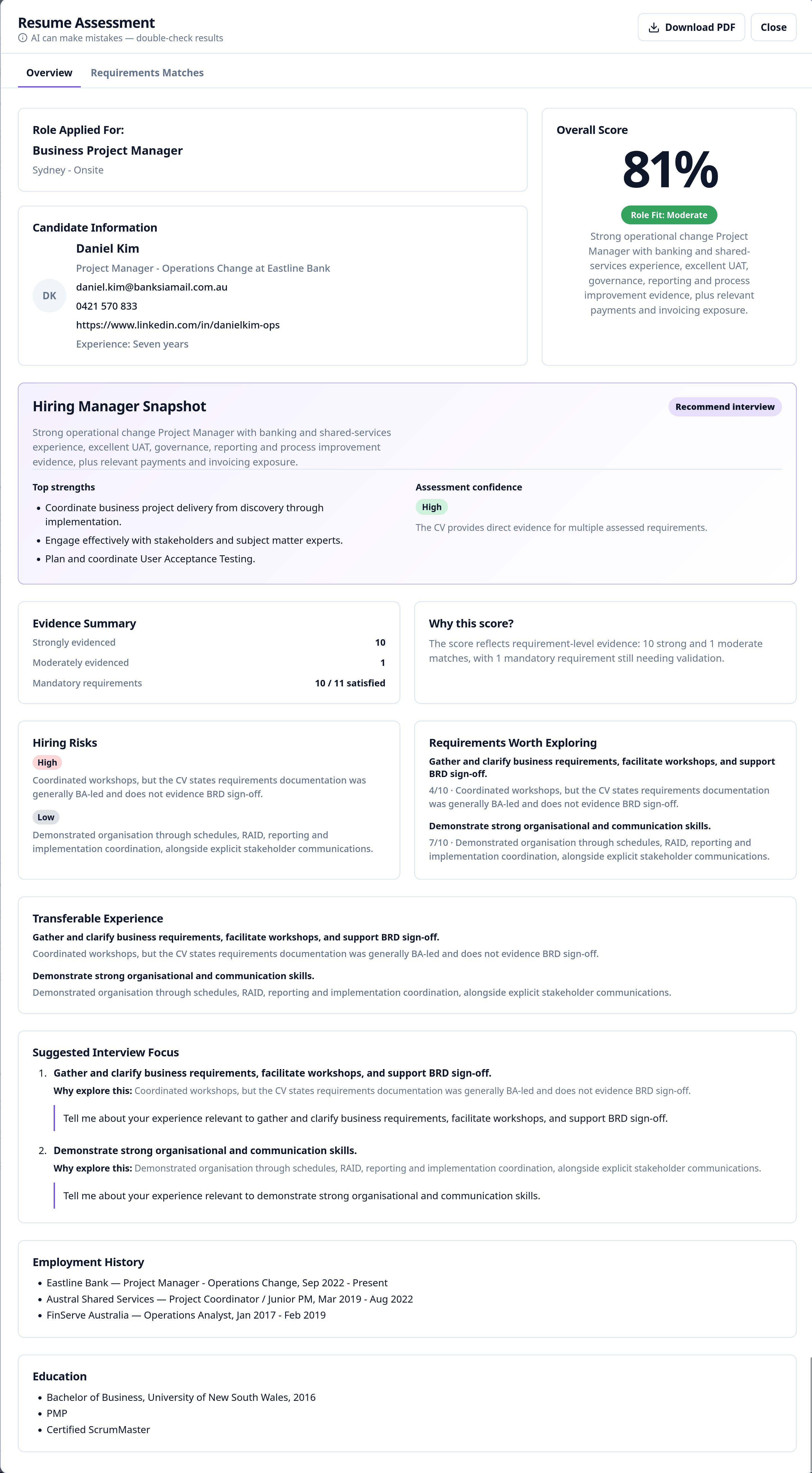
The Overview tab shows the score, role fit band, and Hiring Manager Snapshot including an interview recommendation, hiring risks and sample interview questions to drill down further into a candidate’s experience.
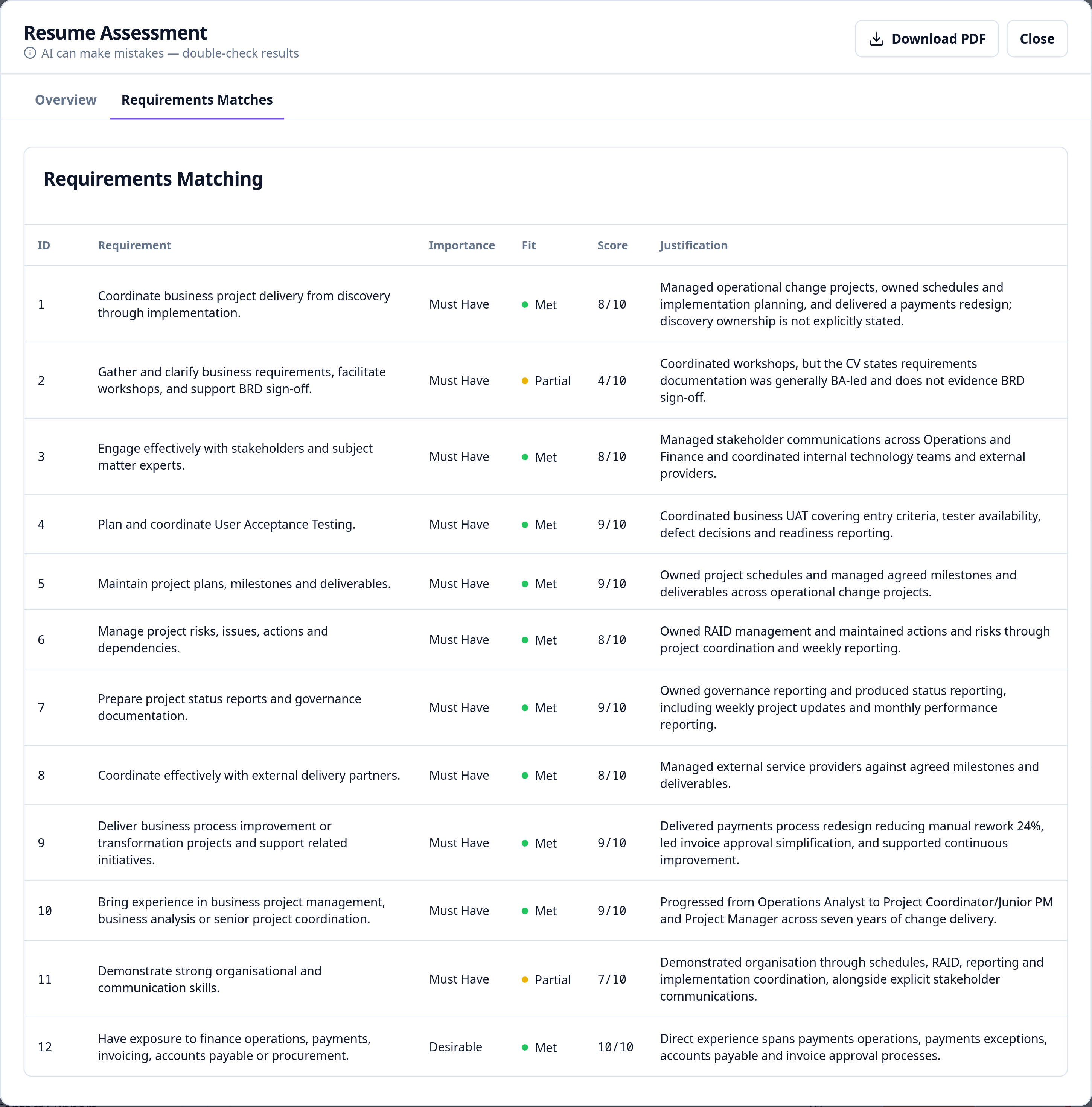
Finally, the Requirements Matches tab breaks down the candidate’s score against each individual job requirement if you want or need that level of detail. For hiring managers reviewing multiple candidates in a session, the modal view keeps everything in one place without switching between files.
The numbers behind the decision
From twelve resumes to a ranked shortlist with evidence behind every position, specific gaps identified for interview, and a clear decision on who to call first. Total time: under three minutes.
An experienced recruiter or talent acquisition screener would probably get through twelve resumes in a few minutes by scanning for the obvious signals. A hiring manager whose day job continues regardless, and whose performance depends on getting this hire right, would likely spend the better part of thirty minutes to an hour reading carefully. Either way, the comparison that results still lives in someone’s head. When a stakeholder asks why these three candidates moved forward and those nine did not, the answer has to be reconstructed from memory and instinct rather than drawn from a structured record.
Requirement-level scoring produces a different kind of output: one that can be shared, challenged, and explained at the level of individual requirements rather than overall impression. For key or sensitive roles, the PDF assessment reports can be emailed directly to stakeholders, giving decision-makers the same evidence base without needing to be in the room when the shortlist was built.
And the best part? You can have your lunch and eat it too!